Alzheimer's Research
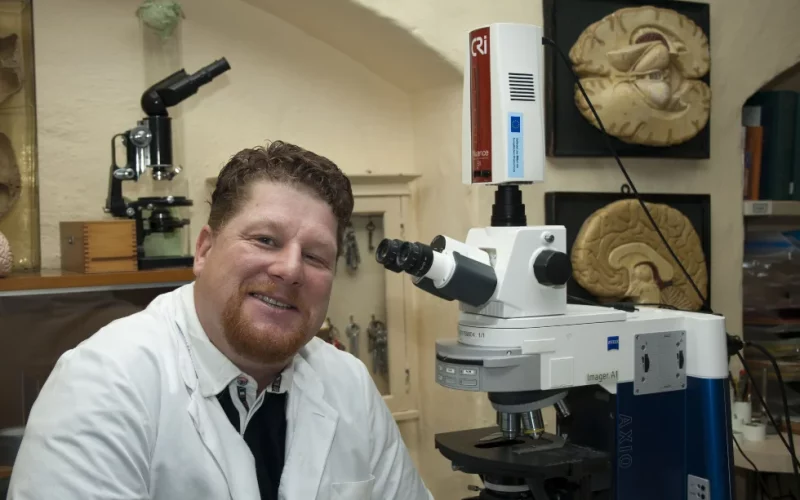
Although there is still no curative therapy for Alzheimer's patients, groundbreaking findings from the studies of Prof. Jens Pahnke show that certain approaches nonetheless promise relief from the first signs of dementia and can ease everyday life for patients and their families.
But how does Alzheimer's actually develop? Early signs include minor forgetfulness, disorientation, and trouble concentrating. What is happening in the brain when this occurs?
Nerve Cells in Gridlock: Why Alzheimer's Disrupts the Flow of Information
The brain works like a city with a complex network of roads. Nerve cells pass information along, while specialised cleaning systems — the ABC transporters — remove waste products and keep traffic flowing smoothly.
In Alzheimer's disease, these cleaning systems fail. Harmful beta-amyloid plaques block the pathways of information, nerve cells die off, and memory performance declines. What matters is not the sheer quantity of deposits: Professor Pahnke explains that it is actually the precursor stage — the fragments — of these nerve-cell-damaging plaques that is responsible for the damage.
This is where Greek mountain tea comes in. The removal of these fragments became the focus of further research into plant-based remedies.
The Role of Greek Mountain Tea in Medicine
Greek mountain tea (Sideritis scardica) has been prized as a natural tonic for centuries, and for more than 20 years it has also been a focus of scientific research.
These studies show that the plant compounds in Greek mountain tea may have a positive effect on the brain, in particular through antioxidant and anti-inflammatory properties that protect nerve cells and reduce harmful deposits.
The concentration of the active compounds is what determines the positive effects. Simply drinking a cup of tea, unfortunately, is not enough — measurable improvements in cognitive performance have only been achieved with highly concentrated extracts, at a daily dose of at least 900 mg.
An overview of suppliers of extracts and tea is available here.
Greek Mountain Tea in Alzheimer's Research
Alongside its traditional use, a growing number of scientific studies on Greek mountain tea now provide increasingly concrete evidence that certain extracts may have a measurable effect on the brain.
A significant breakthrough was achieved by Alzheimer's researcher Prof. Jens Pahnke, who studied intensively the mechanisms behind the breakdown of beta-amyloid deposits.
His mouse studies show that highly concentrated extracts of Greek mountain tea can help dramatically reduce Alzheimer's-typical deposits in the brain. The images below illustrate this effect:

- Before treatment
- The brown deposits (plaques) are clearly visible (mouse study).

- After 50 days
- Following 50 days of treatment with a Greek mountain tea extract (mouse study).
Like all currently available treatment methods, these plant-based active ingredients cannot cure Alzheimer's either. However, according to Prof. Jens Pahnke, there are indications that cognitive impairments from the past 6 to 9 months can be partially reversed and the progression of the disease slowed.
These findings are particularly relevant, as they show that targeted support of brain function may help stabilize the condition for a certain period of time.
Is the effect scientifically proven?
The Optimal Combination: Mountain Tea & St. John's Wort
Studies show that it is not only the choice of plant but also the concentration of the extracts that is decisive. Prof. Jens Pahnke was able to demonstrate that low-strength extractions are ineffective, while an 80% alcohol-water extraction of St. John's wort combined with a 40% alcohol-water extraction of Greek mountain tea produces the best results.
- Greek mountain tea — supports the breakdown of harmful deposits and protects nerve cells.
- St. John's wort — activates the brain's transport mechanisms (ABC transporters), which are essential for removing these deposits.
- Best results — only in combination do the two plant compounds show their best results; ordinary teas or single-ingredient preparations do not achieve this effect.
Tea or extract — which is right for me?
What Do Those Affected Report?
Many patients taking highly concentrated extracts of Greek mountain tea and St. John's wort report noticeable improvements in cognitive function.
Many family members and patients describe clearer mental awareness, improved memory and language ability, and a considerably improved quality of life. The recovery of the ability to interact with their social surroundings in particular contributes significantly to this.
These accounts show that the scientific findings can have real-world effects and mean noticeable improvements to everyday life for many of those affected.
Patient report: Renovare 500 — dosage
After several hospital stays (2019 and 2020), our mother (94) developed pronounced symptoms of dementia.
She became aggressive, had major memory problems, was sad and depressed, no longer recognised her familiar surroundings, and lost her appetite. Very often she would ask to go home, even though she was already at home. She wanted to go to her mother, father, and siblings, and no longer recognised her grandchildren.
Her family doctor prescribed Cerebokan, then Tebifortan, without noticeable success. Mother also had severe neck pain, likely caused by damage to the cervical spine, and was given strong painkillers. After seeing a neurologist, she was diagnosed with moderate dementia of the Alzheimer's type.
For the past 3 months our mother has been taking Renovare 500, 2 capsules in the evening. She is doing significantly better. It is really unbelievable how well her condition has stabilised.
At a routine visit, the family doctor mentioned that St. John's wort should be taken in the morning, or spread out over the day. After several days of a reduced dose of Renovare (1 capsule) in the morning, the familiar dementia symptoms returned.
It's a real shame that this "dietary supplement" is so little known. It was only after extensive research online that I came across Dr. Dr. Pahnke's research findings.
I've found that pharmacies, physicians, and family doctors know little to nothing about this medicine/supplement and how it works.
— A.H., Austria
Patient report: Renovare 500 — preventive use
Dear Prof. Pahnke,
I would like to take this opportunity to thank you for your research and the resulting development of the active-ingredient composition in Renovare 500.
I am 56, and on my father's side my grandfather had Alzheimer's, and my father (91) has also been more or less affected by dementia for years.
As something of a self-experiment, I have been taking Renovare 500 preventively at a dose of 1 tablet per day over the past 4 months. Since then my memory for names has improved considerably.
Names are, after all, quite arbitrary and can't be worked out through reasoning — so they're probably more fleeting than other kinds of memory content compared to other things.
Often it happens that, for example, you can no longer put the right name to the face of an actor or a sports star from the past.
There were quite a few such faces from the past that I can now mostly recall without effort. You can turn it into a kind of game — recall a sporting event, a film, or something similar, and then try to remember the corresponding names.
So thank you again. I hope that in Oslo you found the research conditions you had hoped for and that you deserve.
With best regards,
Mag. W.M., Salzburg
Patient report: Sideritis scardica as a tincture / tea — general reply
Dear Prof. Dr. Dr. Jens Pahnke,
First, let me wish you a happy new year.
For 8 years I have been caring for my wife, who has dementia, at home. After 4 years of illness, her mobility has decreased significantly. My greatest concern, however, has been her increasing aggressiveness. Five years ago she was given melperone as an antipsychotic. After a year she no longer recognised her surroundings, and communication was essentially zero.
I then discontinued the medication and began looking into the use of medicinal herbs. For calming, she now takes St. John's wort, valerian, and CBD cannabis oil.
Testing the right dose was difficult. I cook everything myself every day and always try to follow a healthy diet.
Taking St. John's wort and valerian has helped ease her aggressiveness. In June 2022, while researching cures for dementia, I came across your piece "Greek mountain tea — a remedy from antiquity" on YouTube. I ordered the tea that same day.
Today I would like to write to you about the progress in caring for my wife.
Since July 2022 — 6 months now — my wife has been drinking a litre of the tea every day, with great success. I also made a tincture myself, following your suggestion. Both short- and long-term memory have improved, and communication has increased considerably again.
There has also been further improvement with incontinence — trips to the toilet are possible again. And her general sense of well-being has improved as well.
By changing her diet, I have also managed to keep her blood pressure within the normal range, and her long-term blood-sugar value for type 2 diabetes is at 5.3. She needs no further medication.
So thank you again very much for your helpful work on this disease. I wish you a wonderful time in the best of health.
Kind regards,
K.F., Dipl.-Ing. (FH)
Plauen
Patient report: Renovare 500 — dementia treatment
Dear Prof. Dr. Dr. Pahnke,
We have been giving my mother this remedy since September 2019 and are very happy with how much her condition has improved as a result. We had already considered placing her in a care home — that is no longer necessary now.
It's a shame that health insurers don't support this remedy. It could bring relief to a great many people. We have already recommended it to others.
I do have one question, though. For the past few days my mother has been very tired and sleeping a great deal — could that be related to the remedy? Thanks again for this wonderful medicine.
Kind regards,
UP
Disclaimer: These testimonials are based on individual feedback and do not constitute a promise of a cure; they do not replace medical advice.
Source: pahnkelab.eu/patient-replies
Based on the research of Prof. Pahnke
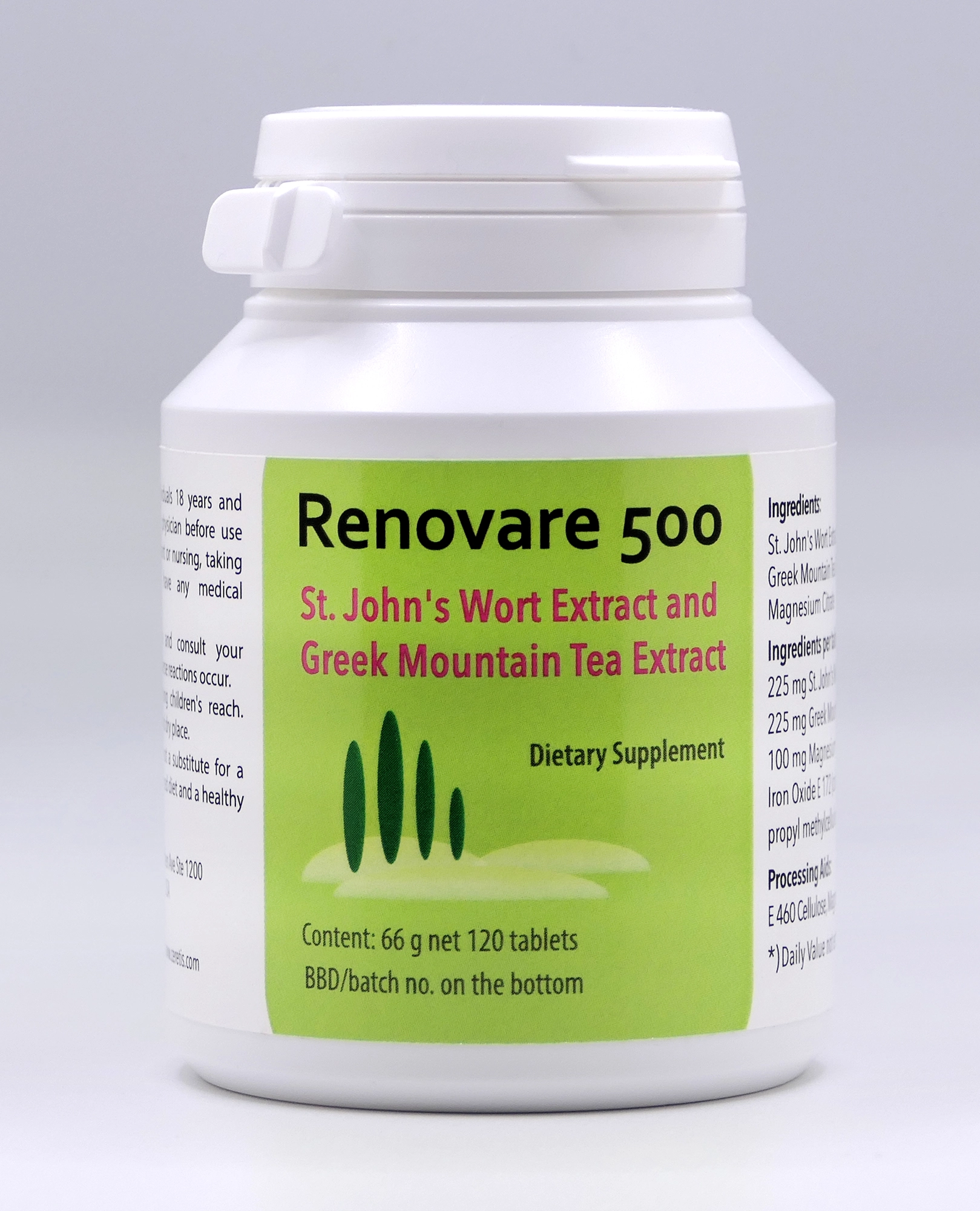
Renovare 500 combination formula
120 capsules of 500 mg, over-the-counter, active ingredients from 225 mg St. John's wort and 225 mg Greek mountain tea extract with 50 mg magnesium citrate.
See sources of supply. What dosage is recommended?
Conclusion
The combination of Greek mountain tea and St. John's wort offers a promising way to support cognitive function. In extensive scientific studies, Prof. Jens Pahnke was able to demonstrate that these plant extracts can help reduce harmful deposits in the brain and promote mental clarity.